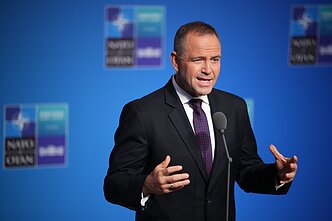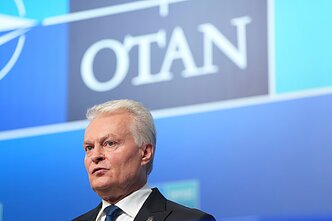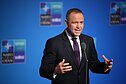
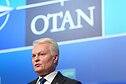







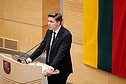

Lithuanian President Gitanas Nausėda has welcomed US commitments to contribute to security guarantees for Ukraine during a virtual meeting of the Coalition of the Willing.
His office said he stressed the need to turn the guarantees into “practical and military reality” without delay.
The coalition met on Tuesday to discuss talks held at the White House a day earlier.
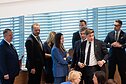
On Monday, Ukrainian President Volodymyr Zelensky met US President Donald Trump in Washington. They were later joined by the leaders of the UK, France, Germany, Italy and Finland, as well as NATO Secretary General Mark Rutte and European Commission President Ursula von der Leyen.
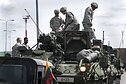
Nausėda said the coalition must be prepared to deploy forces the day after any peace agreement is signed.
Presidential adviser Dainius Žikevičius said Lithuania would send a similar number of troops to Ukraine as it previously contributed to the NATO peacekeeping mission in Afghanistan.
After talks in Alaska on Friday with Russian President Vladimir Putin, Trump said he had discussed security guarantees for Ukraine. He said Putin had agreed, while again rejecting Kyiv’s bid to join NATO.
The guarantees “would be provided by various European countries, with coordination with the United States of America,” he said.
The Financial Times, citing a document it had seen, reported that Ukraine had agreed to purchase $100bn of US weapons, financed by Europe, in return for the guarantees.
Nausėda also said there was no alternative to deterring Russia other than well-trained and sufficiently large Ukrainian armed forces defending their homeland.
His office said he insisted that pressure on Moscow must continue and urged the EU to adopt a 19th package of sanctions against Russia as soon as possible.
“The Kremlin does not deserve any easing of sanctions and has not taken any steps towards achieving a just and lasting peace,” the statement said.

Newsletter
Every Friday morning.